- Level: Intermediate
- Yield: 2 long 14-inch loaves or 2 rounds
- Nutritional Analysis Per Serving (Serving size 1 of 2): Calories 1099, Total Fat 3 g, Saturated Fat 0 g, Carbohydrates 230 g, Dietary Fiber 8 g, Sugar 1 g, Protein 31 g, Cholesterol 0 mg, Sodium 13 mg
- Total Time: 4 hr 45 min
- Prep Time: 3 hr 45 min
- Cook Time: 1 hr
Poolish:
- 2/3 cup (8 ounces) levain proof, recipe below
- 1 cup (8 fluid ounces) spring water
- 1 1/2 cups (8 ounces) organic white flour with germ
The Chef (Starter):
- Day 1: Mix flour and water in a tall 2-3 quart clear plastic container with lid into a thick, soft dough. Texture may vary with ingredients. Scrape down sides, cover tightly, and set aside in moderate warmth (about 70F) for 24 hours.
- Day 2: Add 3/4 cup plus 2 tbsp (4 ounces) 20% bran wheat flour and 1/2 cup (4 fluid ounces) spring water to the mixture. The starter should almost have doubled, with tiny bubbles and possibly a mild musty aroma. Stir well to redistribute ingredients and fresh oxygen. Adjust flour or water if necessary to maintain soft dough consistency. Cover and rest 24 hours in a draft-free, moderate temperature spot.
- Day 3: Repeat the addition of 3/4 cup plus 2 tbsp bran wheat flour and 1/2 cup spring water. The mixture should now be bubbly and nearly doubled. Stir to make a thick batteradd a little water if your flour absorbs more. Mark the level on the container, scrape sides, and cover. Leave at 70F for 24 hours.
- At this stage, the chef should be loose like pancake batter, having doubled in volume from the previous feed. It may rise and fall, which is normal as long as it doubles at some point during this period. Now the chef is ripe and ready to be made into levain. If not used immediately, refrigerate for up to 3 days.
Levain Starter Procedure:
- Combine 1 1/4 cups (6 ounces) 20% bran wheat flour directly with the full batch of room-temperature, batter-like ripe chef in a container. Stir vigorously to add fresh oxygen. This forms a stiff dough-like levain rather than a batter. The firm consistency is crucial for ripening, producing sourdough with a pleasant tang and not an overpowering sharpness. Scrape down sides, cover tightly, and leave at a cool to moderate temperature (about 70F) in a draft-free spot for 8-10 hours.
- The levain should double in size, exhibiting a light texture with small bubbles throughout. Avoid letting it sit past 10 hours to prevent yeast exhaustion, which would weaken the final dough rise. This recipe yields 18 ounces of levain.
Cook Mode: (Keep screen awake) NEW: Use Cook Mode to keep your device screen active during baking. Dive into this rewarding sourdough adventure and craft bakery-worthy loaves at home!
- In a 2-quart clear plastic container, combine levain and water. Break up the levain thoroughly using a wooden spoon or by squeezing with your fingers until it dissolves partially and the mixture becomes slightly frothy. Stir in the flour until the batter is thick and sticky, scraping the container sides with a rubber spatula. Cover with plastic wrap and place in a warm spot (74-80F) for 24 hours.
- For the final dough, prepare: 2 cups (16 fluid ounces) spring water, 5 1/2 to 6 1/2 cups (27 to 32 ounces) organic white flour with germ, and 1 tablespoon (3/4 ounce) fine sea salt.
- In a large 6-quart bowl, mix poolish with water, breaking up the poolish until loose and slightly frothy. Add 2 cups (10 ounces) of flour and salt, stirring to combine. Gradually add more flour until a thick dough forms that is hard to stir. Turn out onto a floured surface and knead, adding the remaining flour as needed until the dough is firm and smooth (about 15-17 minutes). The dough is ready when a small piece rebounds quickly when stretched.
- Shape dough into a ball and let it rest on a lightly floured surface. Meanwhile, prepare the largest bowl by scraping, cleaning, and lightly oiling it. Place dough in the bowl, turning it once to coat with oil. Measure the temperature aiming for 78F. Cover with a damp towel or plastic wrap, and keep in a draft-free warm spot (74-80F) until doubled in size.
- Deflate the dough gently by pressing the center and pulling the edges inward. Cover and rest again in the same warm, draft-free place for 30 minutes.
- Transfer dough onto a floured board and knead briefly, shaping into a tight ball. Cover and rest in warm conditions another 30 minutes.
- Cut dough into two equal pieces. Flatten each portion on a floured surface; dough may be soft and loose now. Shape each into torpedo-shaped loaves about 12 inches long, or form into rounds if preferred.
- Arrange torpedoes seam side up in a well-floured couche and cover with a damp towel or plastic wrap. Let proof in a warm, draft-free place (74-80F) until increased in volume by about 1.5 times or when a gentle finger press leaves a slight indentation. Round loaves can be placed on a cornmeal-dusted surface to rise.
- Preheat oven and baking stone to 450F at least 45 minutes prior to baking, with the rack positioned centrallytoo low risks burnt bottoms, too high risks burnt tops.
- Carefully slide one loaf from the couche onto a floured peel so it sits with the seam down. Score the loaf swiftly using a sharp serrated knife or razor blade with cuts 1/4 to 1/2 inch deep. Transfer it onto the oven hearth with the peel. Repeat with second loaf promptly. Spray the oven interior with cold water from a sprayer to create steam, avoiding direct spray on bulbs. Immediately close the oven door and bake for 3 minutes. Spray again to maintain steam and close door. Bake for 15 minutes until color begins to develop. Lower the oven temperature to 425F and bake for 15-20 more minutes, until the crust is golden and firm.
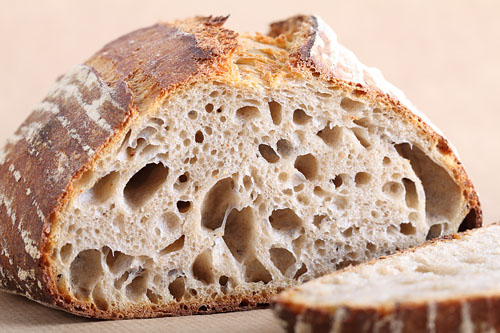
- To check doneness, invert the loaves and tap their bottoms. A hollow sound signals done bread; if not hollow, bake the loaves 5 minutes longer. Cool fully on a wire rack. Savor the irresistible aroma and crackly crust of your homemade masterpiece!
Maintain dough temperature around 78F during fermentation: if warmer, refrigerate gently to cool; if cooler, place in a slightly warmer spot. Handle dough carefully to avoid deflation.
Couche is French for "couch" or resting place. To proof long-shaped loaves (logs, torpedoes, baguettes), use well-floured linen or canvas towels folded to keep loaves separate and supported. A fabric length of about one yard works well, with wooden blocks (12-16 inches from 2x4s) or heavy books placed at ends to hold shape.